
Collective Living
Millennials and Gen Z are increasingly turning to homesteading not out of necessity, but as a deliberate response to climate anxiety, food insecurity, and a growing fatigue with hyper-consumer culture. This shift signals more than a lifestyle trend—it calls for a rethinking of how we design domestic and communal spaces. Younger generations are seeking environments that support self-sufficiency, slower rhythms of living, and a closer relationship to land, food, and craft, while still remaining connected through digital tools that enable learning, remote work, and social exchange.
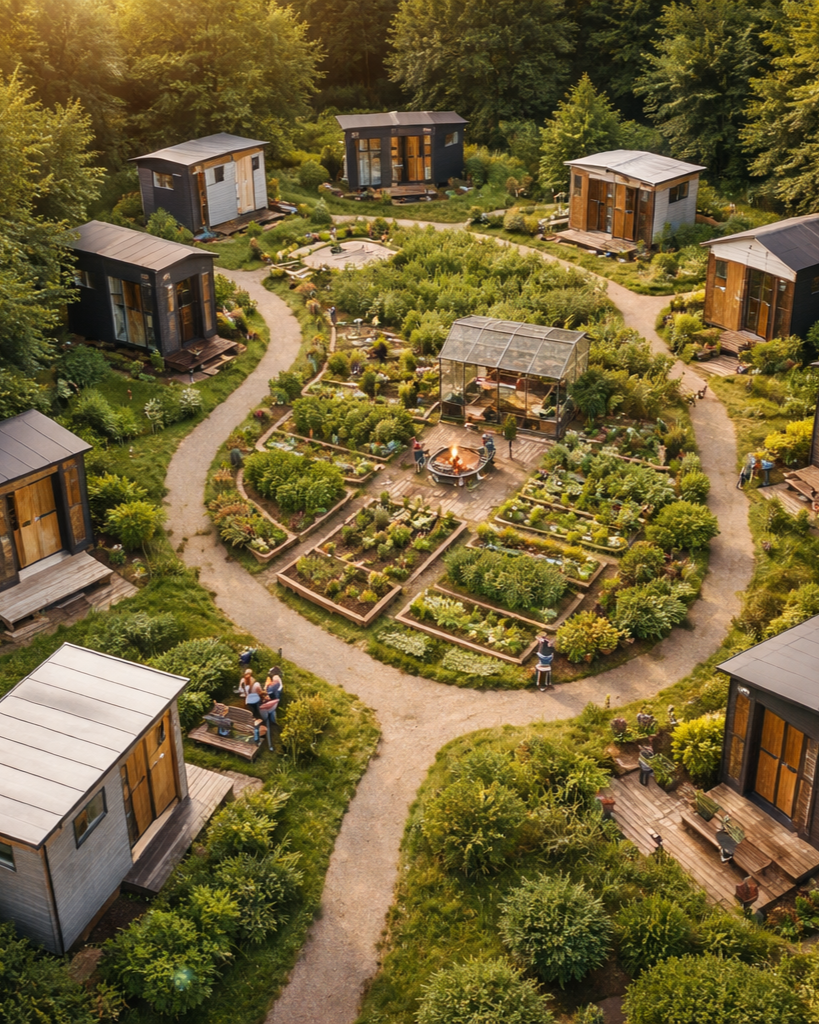
For architects and designers, the implication is clear: we must design spaces that make room for intentional social bonds, shared rituals, and collective care.
Designing for this cultural shift means prioritizing adaptability over excess and community over isolation. Homes no longer need to be optimized solely for privacy and accumulation; instead, they should support shared infrastructure—gardens, kitchens, workshops, and outdoor spaces—that encourage collective making, gathering, and resource sharing. Even in urban contexts, this translates to flexible courtyards, rooftops, and interiors that allow for growing, preserving, and producing, reinforcing a sense of agency within limited footprints.
Projects like “Bestie Row” offer a compelling model. Four couples, disillusioned with suburban sprawl, chose to design their lives around proximity, friendship, and shared time rather than square footage. Their small, efficient homes, costing only 40k and designed by architect Matt Garcia, are anchored by a communal compound that becomes the social heart of the site—an architectural acknowledgment that gathering, not isolation, is the true luxury. Sustainable materials, climate-responsive design, and modest scale support both environmental responsibility and long-term resilience.
For architects and designers, the implication is clear: we must design spaces that make room for intentional social bonds, shared rituals, and collective care. As this generation redefines wealth as time, autonomy, and connection, architecture has an opportunity—and responsibility—to support new forms of living that are grounded, communal, and deeply human.